
A new era for international FootGolf: stronger World Cups, sustainable competition cycles, more hosting opportunities, and a long-term commitment to the development of the sport worldwide.
FIFG President Aleks Kravanja, together with members of the FIFG Competition Committee, presented the new 2027–2036 International FootGolf Competition and Qualification Plan, outlining a comprehensive restructuring of the international competition calendar and a strategic vision for the next decade.
During the presentation, President Kravanja praised the exceptional commitment of the FIFG Competition Committee and its supporting team, who collectively invested hundreds of hours of dedicated work in researching, developing, testing, and refining the new competition structure.
The preparation involved a highly detailed and structured process, including extensive research, analysis of previous international championships, the development of alternative competition models, and numerous simulations to evaluate different scenarios and identify the best possible long-term solution.
The committee examined different World Cup cycles, competition formats, regional qualification systems, and tournament structures, carefully assessing their impact on players, national federations, organizers, and the overall development of FootGolf.
Importantly, the analysis went far beyond sporting considerations. The committee evaluated financial implications, organizational and logistical requirements, human resource capacities, travel demands, tournament duration, hosting opportunities, and the long-term sustainability of each proposed model.
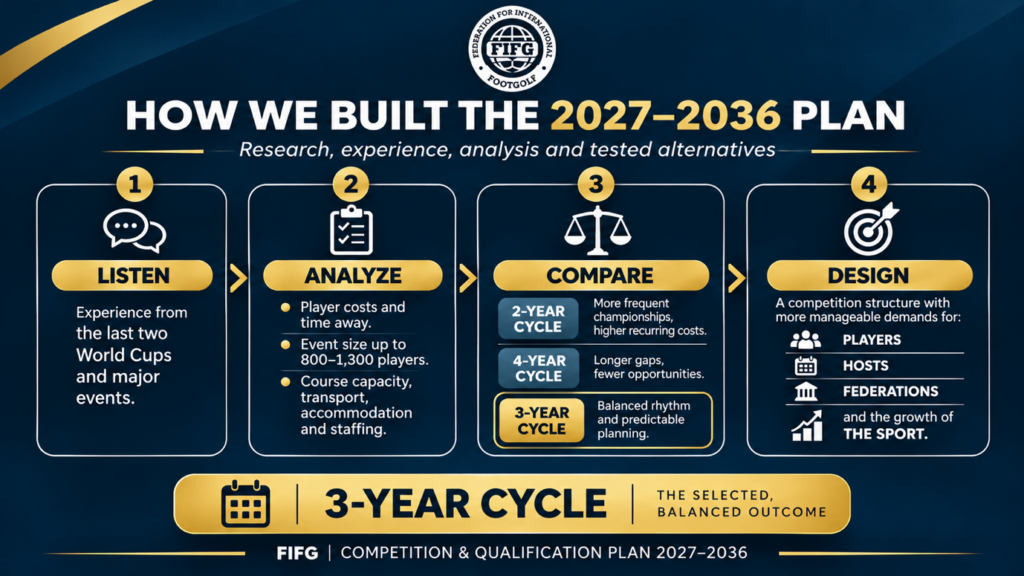
Every major aspect of the competition structure was carefully considered, tested, and evaluated before the final proposal was presented and submitted to the FIFG Board for approval.
President Kravanja emphasized the importance of this extensive preparation and acknowledged the dedication, professionalism, and collaborative efforts of everyone involved.
The result is a carefully researched and structured 10-year competition framework, designed to balance sporting excellence with financial responsibility, organizational feasibility, and the long-term development needs of FIFG member countries.
The central objective is clear: to create a stronger, more sustainable, and more predictable international competition system that benefits players, national federations, tournament organizers, and the global FootGolf community.
A More Sustainable Rhythm for International FootGolf
One of the central decisions behind the new plan is the introduction of a three-year World Cup cycle, replacing the intensive rhythm of major championships taking place every two years.
The Competition Committee recognized that frequent large-scale World Cups create significant demands on national federations, players, and organizers.
For many countries, preparing national teams, organizing qualification competitions, securing funding, and arranging international travel require considerable resources.
When World Cups take place too frequently, national federations can find themselves continuously preparing for the next championship, leaving limited time and financial capacity for other important development activities.
The new structure aims to change this balance.
By introducing a three-year cycle and separating World Cup formats, FIFG intends to give member countries more opportunities to invest in youth development, national competitions, club structures, coaching, and the recruitment of new players.
This additional time is particularly important for developing FootGolf nations, where federations often operate with limited financial and organizational resources.
The goal is not simply to organize fewer large events, but to create more meaningful competitions and allow the sport to grow between them.
At the same time, the annual FIFG World Tour, regional competitions, and new international tournaments will ensure that players continue to have regular opportunities to compete.
Smaller, More Focused World Cups
Another important finding of the Competition Committee’s analysis concerned the size and complexity of previous World Cups.
When individual and national team competitions across all categories are organized within one championship, participation can reach approximately 800 to 1,000 players.
Events of this size require significant infrastructure, multiple golf courses, extensive accommodation arrangements, transportation, staffing, and organizational coordination.
They can also require players to spend up to two weeks or more away from work and family.
The new structure separates major championships into different years and competition formats.
This will make events more manageable, improve playing and organizational conditions, and allow hosts to concentrate on delivering high-quality championships.
The committee’s objective is to reduce the scale of major World Cup events by approximately 30–40%, where appropriate, while maintaining strong international representation and raising competitive standards.
Separating championships will also distribute financial commitments across different seasons, allowing players and federations to plan more effectively.
Three Distinct World Cup Cycles
The new competition plan establishes three major championship cycles, each taking place every three years.
Men’s and Women’s Individual World Cup
2028 | 2031 | 2034
The Men’s and Women’s Individual World Cup will take place every three years.
Qualification will be organized during the year preceding each championship, meaning individual qualification competitions will take place in 2027, 2030, and 2033.
This structure allows players to prepare for clearly defined championship cycles while continuing to compete in the annual World Tour.
Men’s and Women’s National Teams World Cup
2029 | 2032 | 2035
National team championships will follow a separate three-year cycle.
Teams will qualify through the relevant European and Regional Cups in the year before each World Cup.
The qualifying competitions are therefore scheduled for 2028, 2031, and 2034.
This system gives regional competitions greater sporting importance and creates a clear connection between continental performance and World Cup participation.
Separating national team and individual championships will also reduce the financial and time commitments previously associated with participating in both formats during one extended tournament.
Senior and Senior Plus World Cup
2030 | 2033 | 2036
The Senior and Senior Plus categories, for both men and women, will follow their own three-year cycle beginning in 2030.
These championships will combine individual and national team competitions.
Individual qualification will take place in the year preceding each World Cup.
Team qualification is proposed through the relevant European and Regional Cups two years before the championship, with the final timing still to be confirmed.
This structure provides Senior and Senior Plus players with a dedicated international championship cycle while maintaining both individual and team opportunities.
A Special Senior and Senior Plus Individual World Cup in 2028
Recognizing the importance of keeping Senior and Senior Plus players actively involved in international competition, the FIFG Competition Committee proposed a special transitional arrangement for 2028.
Without this additional event, these categories would face a four-year gap between the 2026 World Cup and the introduction of the new combined Individual and Team World Cup in 2030.
To avoid this long interruption, FIFG decided to organize a one-time Senior and Senior Plus Individual World Cup in 2028.
Qualification for this championship will take place in 2027.
The 2028 event will feature individual competition only, allowing Senior and Senior Plus players to participate in a major international championship before the regular three-year cycle begins.
From 2030 onward, the categories will transition to the combined Individual and Team World Cup format, with subsequent editions in 2033 and 2036.
This transitional solution reflects the committee’s commitment to balancing long-term structural changes with the immediate competitive needs of existing players.
Youth World Cup: Investing in the Next Generation and Supporting Equal Opportunities
The FIFG Youth World Cup represents one of the most important initiatives for the long-term development of international FootGolf.
Following the successful first edition of the Youth World Cup, FIFG is committed to continuing and strengthening this competition, recognizing the essential role that young players will have in shaping the future of the sport.
The new competition plan establishes a regular two-year cycle for the Youth World Cup:
2028 | 2030 | 2032 | 2034 | 2036
The objective goes far beyond organizing an international championship. The Youth World Cup is intended to encourage national federations to develop youth programs, strengthen local training and competition structures, and provide young players with opportunities to experience international FootGolf.
However, FIFG also recognizes that participation in international youth competitions can create significant financial challenges, particularly for member countries with limited resources.
To address this issue, a dedicated Youth World Cup Solidarity Fund was established and approved at the last FIFG General Assembly.
The purpose of this fund is to provide financial assistance to young athletes from less financially developed member countries, helping them participate in international championships.
Through this initiative, FIFG aims to reduce financial barriers and ensure that talented young players are not excluded from international opportunities simply because of their country’s economic circumstances.
The fund is intended to support participation costs where resources are available, helping national federations provide opportunities for children who might otherwise be unable to attend.
The long-term ambition is to make the Youth World Cup a truly global competition, where sporting opportunities are increasingly determined by talent, commitment, and development rather than financial capacity.
By combining a regular international championship with dedicated financial support, FIFG is taking an important step toward creating a stronger, more inclusive future for the next generation of FootGolf players.
World Club Trophy: Strengthening Clubs and Building a Sustainable Global Competition
The FIFG World Club Trophy is another key element of the new international competition structure and an important part of FIFG’s long-term strategy to strengthen club-level FootGolf.
Clubs are the foundation of sustainable sporting development. They provide the local environment where new players discover FootGolf, where young athletes develop their skills, and where regular competition helps build strong sporting communities.
The World Club Trophy is designed to give clubs a prestigious international objective while encouraging national federations to invest in stronger domestic club competitions and organizational structures.
Under the current competition plan, the World Club Trophy is scheduled every two years:
2027 | 2029 | 2031 | 2033 | 2035
However, FIFG’s longer-term ambition is to develop the World Club Trophy into an annual international competition, provided that the necessary financial support can be secured.
A central part of this vision is the Club Competition Solidarity Fund, approved at the last FIFG General Assembly.
The fund was established specifically to support the development and accessibility of international club competition.
The objective is to build sufficient financial resources to help cover competition-related expenses and accommodation costs for athletes participating in the final World Club Trophy competition.
If the Solidarity Fund reaches the required financial capacity, FIFG aims to reduce the financial burden on participating clubs and players, making international club competition more accessible to a wider range of countries.
This support is particularly important for clubs from developing FootGolf nations, where the costs of international participation can otherwise represent significant obstacles.
The possibility of moving to an annual World Club Trophy will therefore depend on the long-term sustainability and financial capacity of the Solidarity Fund.
The ambition is to create a strong, accessible, and financially sustainable international club competition that can eventually take place every year.
By connecting the development of club competitions with a dedicated financial support mechanism, FIFG aims to strengthen the entire club ecosystem, create new international opportunities, and support the continued global expansion of FootGolf.
The FIFG World Tour Remains an Annual Competition
The FIFG Individual World Tour will continue every year from 2027 through 2036, providing a consistent international competition platform between major championships.
Each annual World Tour season will include Main Events and a Grand Final.
Maintaining an annual World Tour is an essential part of the new competition model.
It ensures that players continue to have regular international competitive opportunities even when their World Cup category is not scheduled in a particular year.
The World Tour also supports international tournament organizers and provides continuity for players, clubs, and national federations.
Together with regional competitions, it forms an important part of the broader international FootGolf calendar.
Regional Cups and a Clearer Qualification Pathway
The new competition structure places increased importance on European and Regional Cups as qualification pathways for major World Cups.
For Men’s and Women’s National Teams World Cups, qualification will take place through the relevant Euro and Regional Cups in the preceding year.
For Senior and Senior Plus combined World Cups, the proposed structure provides for team qualification through Euro and Regional Cups two years before the championship, subject to final confirmation.
Individual qualification will take place one year before the respective World Cup.
For European countries, qualification for both the Men’s and Women’s Euro and the Senior and Senior Plus Euro will take place in the year before the relevant continental championship.
This coordinated approach will create a clearer sequence of national, regional, and world-level competitions.
It will also help national federations prepare their domestic calendars, select national teams, plan qualification events, and establish more predictable budgets.
More Countries, More Hosting Opportunities
An important objective of the new competition plan is to make hosting international FootGolf events more accessible to a wider range of member countries.
Previously, organizing a large combined World Cup required substantial infrastructure and resources, limiting the number of countries realistically able to host such events.
By separating individual and national team competitions and reducing the scale of individual championships, FIFG aims to create more manageable hosting requirements.
This will open opportunities for smaller countries and developing FootGolf nations to organize major international tournaments.
Separating championships also means that different countries can host individual and national team World Cups, rather than concentrating both formats in one location.
Hosting international competitions can support regional development, encourage cooperation between neighboring associations, and help national federations gain valuable organizational experience.
The new structure therefore aims to support not only stronger international championships, but also the geographical expansion of FootGolf.
The 2027–2036 International Competition Calendar
The new 10-year calendar establishes a predictable schedule for the main FIFG competitions.
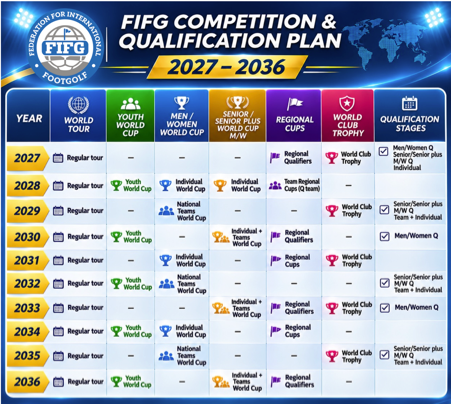
The FIFG Individual World Tour, including Main Events and the Grand Final, will continue annually throughout the entire period.
European and Regional Cups, together with their respective qualification stages, will complement the championship calendar.
The plan also includes qualification activities in 2036 for competitions scheduled in 2037, ensuring continuity beyond the initial 10-year period.
Better Planning for Players and Member Countries
One of the greatest benefits of the new structure is the predictability it provides.
With major championships scheduled years in advance, national federations will be able to plan qualification competitions, national team selection, travel arrangements, and financial commitments more effectively.
Players will have clearer information about when they need to qualify and when their major championships will take place.
Tournament organizers will also benefit from a more stable international calendar, allowing better coordination between national, regional, and world-level competitions.
Most importantly, the longer World Cup cycle will create valuable time for member countries to invest in the development of FootGolf.
Instead of concentrating their resources almost continuously on preparing for the next World Cup, federations will have more opportunities to strengthen their national structures, expand participation, and develop the sport at grassroots level.
A Long-Term Vision for Sustainable Growth
The 2027–2036 Competition and Qualification Plan represents an important strategic step for international FootGolf.
It is built around several connected objectives: improving the quality of World Cups, reducing unnecessary financial and logistical pressure, strengthening regional qualification systems, expanding hosting opportunities, and supporting the development of FootGolf across all categories.
The FIFG Competition Committee’s extensive research and modeling demonstrated the importance of finding a more sustainable balance between international competition and national development.
The new three-year World Cup rhythm is intended to create that balance.
International championships should be the highlight of a development cycle, not a continuous pressure that limits the ability of member countries to grow the sport.
By creating a predictable long-term structure, FIFG aims to provide players, federations, and organizers with the stability needed to prepare effectively and invest in the future.
Next Steps
Following the presentation and approval of the new competition plan, FIFG will continue with the implementation process.
This will include the preparation of hosting bid documents, the development of detailed qualification regulations, and coordination with member federations regarding future championships.
Particular attention will be given to the 2028 Individual World Cups, including the transitional Senior and Senior Plus championship, the Youth World Cup, and the qualification processes connected to upcoming international events.
Further details regarding competition regulations, qualification procedures, and hosting opportunities will be communicated to FIFG member countries.
Building the Future of International FootGolf Together
The new 10-year competition plan reflects FIFG’s commitment to building a stronger, more sustainable, and more inclusive international competition system.
It recognizes that the future of FootGolf depends not only on successful World Cups, but also on the strength of national federations, regional competitions, clubs, youth development programs, and the wider FootGolf community.
By creating a more balanced international calendar, FIFG aims to give every part of the sport greater opportunities to develop.
Stronger World Cups. A more sustainable competition rhythm. More hosting opportunities. More time for development.
One long-term vision for the future of international FootGolf.
Federation for International FootGolf (FIFG)


